Wednesday, February 3, 2021

Early Filmmaking and Exhibition

Early Filmmaking and Exhibition

1)The cinema may have been an astonishing novelty in the 1890s, but it came into being
    within a varied context of Victorian leisure-time activities.

2) Dramatic troupes put on plays, lecturers used magic-lantern slides to illustrate their talks,
    and concerts featuring the newly invented phonograph brought the sounds of big-city
    orchestras to a wide public.
3)Vaudeville gave middle-class audiences a variety of acts on a single program, ranging from
   performing animals to plate-spinning jugglers to slapstick comedians.
4)Burlesque offered a similar potpourri of acts, though less family-oriented with their vulgar
  comedy and occasional nudity.

The new medium of film
1)moved smoothly into this spectrum of popular entertainment.
2)Like the early films that we have already mentioned, most subjects were nonfiction,
   or actualities
.
3)Actualities - These included scenics, or short travelogues, offering views of distant lands.
   News events might be depicted in brief topicals
.

From the beginning, fiction films were also important.
1)Typically these were brief staged scenes.
2)The Lumières’ Arroseur arrosé AKA The Waterer Watered, presented in their first program
   in 1895, showed a boy tricking a gardener by stepping on his hose.
3)Such simple jokes formed a major genre of early filmmaking.
4)Some of these fiction films were shot outdoors, but simple painted backdrops were quickly
   adopted and remained common for decades.

The Waterer Watered (Auguste & Louie Lumière, 1895) 
Info on YouTube
The world's 1st comedy, The Sprinkler Sprinkled (also known as L'Arroseur Arrosé and The Waterer Watered) was shot in Lyon in the spring of 1895. The film portrays a simple practical joke in which a gardener is tormented by a boy who steps on the hose that the gardener is using to water his plants, cutting off the water flow. When the gardener tilts the nozzle up to inspect it, the boy releases the hose, causing the water to spray him. The gardener is stunned and his hat is knocked off, but he soon catches on. A chase ensues, both on and off-screen (the camera never moves from its original position) until the gardener catches the boy and administers a spanking. Louis Lumière used his own gardener, François Clerc, to portray the gardener.

Click Here for the Water Watered film


Filmming styles
1) Most films in this early period consisted of a single shot.
2)The camera was set up in one position, and the action unfolded during a continuous take.
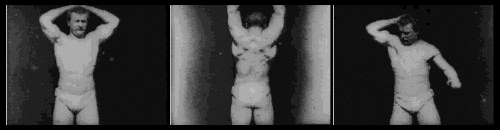
3)Film historian Jon Lewis describes the visual style of Sandow (1886): Edison's filmmakers -
   W. K. L. Dickson, James White, and William Heise - opted for an aesthetic that closely
   mimicked photographic portraiture.
4) Subjects were placed in front of a flat black backdrop and lit from the front.
5)No effort was made at simulating depth within the two-dimensional image.

Sandow (W. K. L. Dickson & William Heise, 1896)
from YouTube: SUMMARY According to vaudeville historian Joe Laurie, Jr., Sandow--who was managed by Flo Ziegfeld--was "the greatest of the strong men and who received the most publicity" (Vaudeville, 1972, p. 33).
Click Here for Sandow clip

Blacksmithing Scene (1893)

1)Blacksmithing Scene is an 1893 American short black-and-white silent film directed by
   William K. L. Dickson.
2)It is historically significant as the first Kinetoscope film shown in public exhibition on
   May 9, 1893, and is the earliest known example of actors performing a role in a film
.


Blacksmithing Scene (W. K. L. Dickson & William Heise, 1893)
Blacksmithing Scene film clip

Notes from YouTube:

Blacksmith Scene (1893) - 1st Staged Narrative in Film - William K.L. Dickson | William Heise

The 1st commercially exhibited film and the 1st staged scene with actors performing a role, Blacksmith Scene is a Kinetoscope film first shown on May 9, 1893.  It was filmed entirely within the Black Maria studio at West Orange, New Jersey, in the USA, which is widely referred to as "America's First Movie Studio".

The scene is all filmed from a stationary camera. On screen is a large anvil with a blacksmith behind it and one to either side (portrayed by Edison employees). The smith in the middle uses a heated metal rod he has removed from a fire and places it on the anvil. All three begin a rhythmic hammering. After several blows the metal rod is returned to the fire. One smith pulls out a bottle of beer, and they each take a drink. Following this drink they then resume their work.

American Developments

 American Developments

The Mutoscope (1894)


Woodville Latham and his sons Otway and Gray
1) Make one considerable contribution to film technology.
2)Most cameras and projectors could use only a short stretch of film,
   lasting less than three minutes, since the tension created by a longer, heavier roll would
   break the film. 
3)The Lathams added a simple loop to create slack and thus relieve the tension, allowing much
   longer films to be made.
4)The Latham loop has been used in most film cameras and projectors ever since.
5) Indeed, so important was the technique that a patent involving it was to shake up the entire
     American film industry in 1912.

C. Francis Jenkins and Thomas Armat
1) A second group of entrepreneurs, the partnership of C. Francis Jenkins and Thomas Armat,
    first exhibited their Phantoscope projector at a commercial exposition in Atlanta in
    October 1895, showing Kinetoscope films.
2)Partly because of competition from the Latham group and a Kinetoscope exhibitor,
    who also showed films at the exposition, and partly because of dim, unsteady projection,
    the Phantoscope attracted skimpy audiences.
3) Later that year, Jenkins and Armat split up.
4) Armat improved the projector, renamed it the Vitascope, and obtained backing from
   the entrepreneurial team of Norman Raff and Frank Gammon.
5) Raff and Gammon were nervous about offending Edison, so in February they demonstrated
   the machine for him.
6) Since the Kinetoscope’s initial popularity was fading, Edison agreed to manufacture
    Armat’s projector and supply films for it.
7) For publicity purposes, it was marketed as
   “Edison’s Vitascope,” even though he had no hand in devising it.

The Vitascope’s public premiere
1) was at Koster and Bial’s Music Hall in New York on April 23, 1896.
2) Six films were shown, five of them originally shot for the Kinetoscope;
3) the sixth was Acres’s Rough Sea at Dover, which again was singled out for praise.
    The showing was a triumph.
4) Although it was not the first time films had been projected commercially in the United
    States, it marked the beginning of projected movies as a viable industry there.

Herman Casler patented the Mutoscope
1) In late 1894, Herman Casler patented the Mutoscope, a flip-card device.
2) He needed a camera, however, and sought advice from his friend W. K. L. Dickson,
   who had terminated his working relationship with Edison.
3)With other partners, they formed the American Mutoscope Company.
4) By early 1896, Casler and Dickson had their camera, but the market for peepshow
    movies had declined, and they decided to concentrate on projection.
5)Using several films made during that year, the American Mutoscope Company soon had
    programs playing theaters around the country and touring with vaudeville shows.
6)The camera and projector were unusual, employing 70mm film that yielded larger,
   sharper images.
7)By 1897, American Mutoscope was the most popular film company in the country.
8)That year the firm also began showing its films in penny arcades and other entertainment
   spots, using the Mutoscope.
9)The simple card holder of the Mutoscope was less likely to break down than was the
   Kinetoscope, and American Mutoscope soon dominated the peepshow side of film exhibition
    as well.
10)Some Mutoscopes remained in use for decades.

By 1897, the invention of the cinema was largely completed.
1) There were two principal means of exhibition: peepshow devices for individual viewers
     and projection systems for audiences.
2) Typically, projectors used 35mm film with sprocket holes of similar shape and placement,
    so most films could be shown on different brands of projectors.

*But what kinds of films were being made?
*Who was making them?
*How and where were people seeing them?


Tuesday, February 2, 2021

European Contributions

European Contributions


LUMIERE BROTHERS - Louis and Auguste
1) The Lumière brothers, Louis and Auguste,
2) invented a projection system that helped make the cinema a commercially viable enterprise
   internationally.
3)Their family company, Lumière Frères, based in Lyon, France, was the biggest European
   manufacturer of photographic plates.
4) In 1894, a local Kinetoscope exhibitor asked them to produce short films that would be
   cheaper than the ones sold by Edison.
5) Soon they had designed an elegant little camera, the Cinématographe,
   which used 35mm film and an intermittent mechanism modeled on that of the sewing
    machine.
6) The camera could serve as a printer when the positive copies were made.
7)Then, mounted in front of a magic lantern, it formed part of the projector as well.
8) One important decision the Lumières made was to shoot their films at sixteen frames per
   second (rather than the forty-six frames per second used by Edison);
9)this rate became the most commonly used international film speed for about twenty years.
10) The first film made with this system was Workers Leaving the Factory, apparently shot in
      March 1895.
11) It was shown in public at a meeting of the Société d’Encouragement pour l’Industrie
      Nationale in Paris on March 22.
12) Six further showings to scientific and commercial groups followed, including additional
      films shot by Louis.

Workers Leaving the Factory (Auguste & Louie Lumière, 1895)
Click Here for first Lumiere Film

DECEMBER 28, 1895 - Exploiting the success
On December 28, 1895, one of the most famous events in film history took place.
1)The location was a room in the Grand Café in Paris.
2)In those days, cafés were gathering spots where people sipped coffee, read newspapers, and
    were entertained by singers and other performers.
3)That evening, fashionable patrons paid a franc to see a twenty-five minute program of ten
   films, about a minute each.
4)Among the films shown were a close view of Auguste Lumière and his wife feeding their
   baby, a staged comic scene of a boy stepping on a hose to cause a puzzled gardener to squirt
   himself (later named L’arroseur arrosé, or “The Waterer Watered”), and a shot of the sea.
5)Although the first shows did moderate business,
6) within weeks the Lumières were offering twenty shows a day,
7) with long lines of spectators waiting to get in.
8)They moved quickly to exploit this success,
   sending representatives all over the world to show films and make more of them.

Baby's Meal (Auguste & Louie Lumière, 1895)
Click Here for clip of Baby's Meal


Ian Christie
1) Film scholar Ian Christie gives an interesting lecture on the first film exhibitions.
2) The reception of moving pictures in 1894-96 has been much mythologised.
3)Were spectators really frightened of an approaching train?
4) Did they imagine seeing their departed relatives reanimated on screen?
5) How much attention was actually paid to this new phenomenon among so many
   contemporary novelties and wonders?
6) Moving pictures may not have been the innovation once claimed, but within a
   decade few could doubt that they had become a major force in changing the
   Edwardian world.

What Really Happened at the First Moving Picture Shows (Gresham College, 2018) Click Here for Ian Christie lecture 49:47 minutes

Describes Britain's film past and the Eidophusikon

Duration of Magic Lantern Shows - end of 18th beginning of 19th - accompanied by speech and music. History goes back to 16th - 17th century. Continues to this day, The Magic Lantern Society in London. 
Kinetoscope - wholesome, refined and suitable for ladies. Movie Theatres later were not suitable for women. 
Cinematograph - demonstrated through 1895 - by Lumiere's
Bioscope - sept in Berlin demonstrated 1895 first in field
Robert Paul - developed his own camera and was going to do a projector
Salon Indien - recreated in an exhibition last year - extravagantly decorated room. Neither Lumiere brother were interested in showing it, their father was. After 1st show not attended until people brought friends - took off by word of mouth. Enormous success, 2,500 francs a day. 6-8 shows a day. ran until 1900. A lack of evolution - 30 second films. 
Their first film, leaving the factory. Not casually shot, was choreographed. Version 3 - bicycle and dogs. First film they found suitable for showing to public. 50 second bits of celluloid for next many years.
George Melies - magician wants to buy them. Heard Robert Paul is willing to sell projectors after his presentation. Bought one of them from R.W. Paul and sawed off name and tried to pass it as here. 
Paul offered a residency at the Alhambra in London. Grandest music halls in London in 1896 - projects from behind the curtain. 
Suggested he do more entertaining. 
A Soldier's Courtship (1896) Huge boost to program - when fiction enters the program otherwise live events or simply filmed. 
Paul also filmed topical events - filmed The Prince's Derby (1896) one of his most celebrated films. 
The Train - Vertical screening gave some depth - Cinema's founding myth - hammed up that they ran screaming from the auditorium - evidence? 

Liquid, mobile and luminous - metal with smoke rising...appearance of vapor. Also the movement of the sea mesmerized audiences. Some had never seen the sea. Seeing things they never witnessed...i saw it at the movies - there it is for real. 

Accompanist music - anything with a C motif - shot for the kinetoscope the sea...Thomas Edison put into his projected show on Broadway. British Sea subject. 
Paul - later - "The appeal of the sea, just feet from your chair. A sea cave near England. He copyrighted this film. An artistic film, but the sea is the subject. 

BBC mark of 100 years of Cinema - presented on Saturday on 8pm...Program called 
Tales from the City. Terry Gilliam narrates. References this Documentary film clip
Theaters at first were known as dingy and disreputable places. People would come and go when they wanted. People would come in sick - where huge hats in front of you. Drink liquor. Unruly - the gloom had unlocked their inhibitions - popular with prostitutes. Man tried to kill himself at the same time as a man did on the screen. This was in England, in France they attracted the creme of society. Some woman changed it like in paris and usherettes, a foyer to meet their freinds. Just like paris. Madame Vasaieller -- opened them in Russia. 
In 1908 a new type of cinema appeared...summarizes audiences and bx in 1890's 


England
1) At the same time that the Lumière brothers were developing their system,
2) a parallel process of invention was going on in England.
3) The Edison Kinetoscope had premiered in London in October 1894,
     and the parlor that displayed the machines did so well that its owners asked R. W. Paul,
      a producer of photographic equipment, to make some extra machines for it.
4) For reasons that are still not clear, Edison had not patented the Kinetoscope outside the
    United States, so Paul was free to sell copies to anyone who wanted them.
5) Since Edison would supply films only to exhibitors who had leased his own machines,
     Paul also had to invent a camera and make films to go with his duplicate Kinetoscopes.

Paul and Birt Acres 1895
1)By March 1895, Paul and his partner, Birt Acres, had a functional camera,
   which they based partly on the one Marey had made seven years earlier for analyzing
   motion.
2)Acres shot thirteen films during the first half of the year, but the partnership broke up.
3) Paul went on improving the camera, aiming to serve the Kinetoscope market,
4) while Acres concentrated on creating a projector.
5) On January 14, 1896, Acres showed some of his films to the Royal Photographic Society.
6) Among those was Rough Sea at Dover, which became one of the most popular first films.

Rough Sea at Dover (Birt Acres, 1896)
Click Here for the film

Edison, Dickson, and the Kinetoscope

Edison, Dickson, and the Kinetoscope


Thomas Edison & Dickson
1) 
In 1888, Thomas Edison, already the successful inventor of the phonograph and the electric
    light bulb, decided to design machines for making and showing moving photographs.
2)Much of the work was done by his assistant, W. K. L. Dickson.
3)Since Edison’s phonograph worked by recording sound on cylinders,
    the pair tried fruitlessly to make rows of tiny photographs around similar cylinders.
4) In 1889, Edison went to Paris and saw Marey’s camera, which used strips of flexible film.
5)Dickson then obtained some Eastman Kodak film stock and began working on a new type of
    machine.
6) By 1891, the Kinetograph camera and Kinetoscope viewing box were ready to be patented
   and demonstrated.
7) Dickson sliced sheets of Eastman film into strips 1 inch wide (roughly 35 millimeters),
    spliced them end to end, and punched four holes on either side of each frame so that
    toothed gears could pull the film through the camera and Kinetoscope.
8)Dickson’s early decisions influenced the entire history of the cinema;
9)35mm film stock with four perforations per frame remained the norm for over a hundred
   years.
10)(Amazingly, an original Kinetoscope film can be shown on a modern projector.)
11) Initially, however, the film was exposed at about forty-six frames per second—much
       faster than the average speed later adopted for silent filmmaking.

Edison Kinetograph Horizontal Camera Replica

Click Here for clip on how it worked

1)Before Edison and Dickson could exploit their machine commercially,
   they needed films.
2)They built a small studio, called the Black Maria, on the grounds of Edison’s New Jersey
   laboratory and were ready for production by January 1893.
3)The films lasted only twenty seconds or so—the longest run of film that the Kinetoscope
   could hold.
4)Most films featured well-known sports figures, excerpts from noted vaudeville acts, or
    performances by dancers or acrobats.

Edison and Phonograph & Kinetoscope Merchandising
1)Edison had exploited his phonograph by leasing it to special phonograph parlors,
   where the public paid a nickel to hear sound through earphones.
2) (Only in 1895 did phonographs become available for home use.)
3) He did the same with the Kinetoscope.
4) On April 14, 1894, the first Kinetoscope parlor opened in New York.
5) Soon other parlors, both in the United States and abroad, exhibited the machines.
6) For about two years the Kinetoscope was highly profitable,
    but it was eclipsed when other inventors,
7) inspired by Edison’s new device, found ways to project films on a screen.

Kinetoscope from "Edison" American Experience episode (PBS, 2015)
Clip of Edison - Eastman and Dickson work

Notes from film : Marey filmed birds with a gun type of machine. 
You have to have film that stops, get the image stops and does that 20-30 times a second need film strong and sensitive enough to do. Advance the film - stop it. 


Monday, February 1, 2021

Major Precursors of Motion Pictures

Major Precursors of Motion Pictures

Muybridge with Leland Stanford's Horses


Some inventors made important contributions without creating moving photographic images. Several men were simply interested in analyzing motion.

1) In 1878, ex-governor of California Leland Stanford asked photographer Eadweard Muybridge to find a way of photographing running horses to help study their gaits.
The Horse in Motion
2)Muybridge set up a row of twelve cameras, each making an exposure in one-thousandth
  of a second.
3)The photos recorded one-half-second intervals of movement.
4)Muybridge later made a lantern to project moving images of horses,
5)but these were drawings copied from his photographs onto a revolving disc.
6)Muybridge did not go on to invent motion pictures,
7)but he made a major contribution to anatomical science
8)through thousands of motion studies using his multiple-camera setup.

Eadweard Muybridge: Studies in Motion
Click here for Muybridge film

Eadweard Muybridge - Studies in Motion (Sothebys, 2017)

description: Eadweard Muybridge’s pioneering studies of motion are some of the most recognized images in the history of photography. His subjects ranged from exotic animals in locomotion to dancers – each displaying a playful and inquisitive eye. Muybridge’s determination to capture motion famously led to his proving that a horse does in fact pick all four hooves up from the ground when it gallops, a popularly debated question of the day.  Real filmmaking would begin 2 years later. 

Muybridge's Zoopraxiscope (Kingston Museum)
Click Here for Muybridge's Zoopraxiscope

Zoopraxiscope definition, an early type of motion-picture projector, designed by Eadweard Muybridge, in which the images were drawings or photographs .

In 1882, inspired by Muybridge’s work,
French physiologist Étienne Jules Marey
1) studied the flight of birds and other rapid animal movements
2) by means of a photographic gun.
3) Shaped like a rifle, it exposed twelve images around the edge of a circular glass plate
    that made a single revolution in one second.
4)In 1888, Marey built a box-type camera that used an intermittent mechanism
    to expose a series of photographs on a strip of paper film at speeds of up to
   120 frames per second.
5)Marey was the first to combine flexible film stock and an intermittent mechanism in
   photographing motion.
6)He was interested in analyzing movements rather than in reproducing them on a screen,
7) but his work inspired other inventors.
8)During this period, many other scientists used various devices to record and analyze motion.

Étienne-Jules Marey: Sport in the Darkroom (The Olympic Museum, 2017)
Click Here for Etienne film clip

A fascinating and isolated figure in the history of the invention of the cinema was Frenchman Émile Reynaud.
1)In 1877, he had built an optical toy, the Projecting Praxinoscope.
2)This was a spinning drum, rather like the Zoetrope,
3) but one in which viewers saw the moving images in a series of mirrors
     Rather than through slots.
4)Around 1882, he devised a way of using mirrors and a lantern to project a brief series of
   drawings on a screen.
5) In 1889, Reynaud exhibited a much larger version of the Praxinoscope.
6) From 1892 on, he regularly gave public performances using long, broad strips of hand-
    painted frames.
7)These were the first public exhibitions of moving images,
    though the effect on the screen was jerky and slow.
8)The labor involved in making the bands meant that Reynaud’s films could not easily be
    reproduced.
9)Strips of photographs were more practical, and in 1895 Reynaud started using a camera to
   make his Praxinoscope films.
10)By 1900, he was out of business, however, due to competition from other, simpler motion-
     picture projection systems.
11)In despair, he destroyed his machines, though replicas have been constructed.

The praxinoscope is essentially a zoetrope that uses mirrors.


Projection Praxinoscope  

Click Here for clip of Projection Praxinoscope

Praxinoscope Theatre

Click Here for clip of Projection Praxinoscope

Another Frenchman came close to inventing the cinema as early as 1888
1)Six years before the first commercial showings of moving photographs.
2)That year, Louis Le Prince, working in England, was able to make some brief films,
   shot at about sixteen frames per second, using Kodak’s recently introduced paper
   roll film.
3)To be projected, however, the frames needed to be printed on a transparent strip;
4)lacking flexible celluloid, Le Prince apparently was unable to devise a satisfactory
   projector.
5) In 1890, while traveling in France, he disappeared, along with his valise of patent
   applications, creating a mystery that has never been solved.
6)His camera was never exploited commercially and had virtually no influence on the
   subsequent invention of the cinema.

INTRODUCTION TO A FILM CLIP

Roundhay Garden Scene is an 1888 short silent actuality film recorded by Le Prince.
1) Filmed at Oakwood Grange in Roundhay, Leeds in the north of England on 14
     October 1888, it is believed to be the oldest surviving film in existence.

Click here for Roundhay Garden Scene clip

Digital archivist Denis Shiryaev upscaled Roundhay Garden Scene in 2020 at 4K (60 fps) Upgraded with modern technology Click Here for Denis Shiryaev clip

12 frames per second so slow  - the original. 


Cine 20A The Invention and Early Years of the Cinema (1880s-1904)

The Invention and Early Years of the Cinema (1880s-1904)

 Cine 20A Course Introduction


The Great Train Robbery (Edwin S. Porter, 1903)

Learning Objectives
By the end of this module, you will be able to:

Examine the technology that led to the development of cinema such as the phenakistoscope, zoetrope, and praxinoscope.

Compare the early photographic experiments of Eadweard Muybridge and Étienne-Jules Marey.

Examine the early films of European pioneers such as the Lumière Brothers, George Méliès, and R. W. Paul.

Assess the contributions of Thomas Edison and William K. L. Dickson on the evolution of American Cinema.

Identify the elements of early actualities and fiction (narrative) films.

Evaluate the establishment of narrative conventions in films by British filmmakers such as Cecil Hepworth, James Williamson, and G. A. Smith.

Examine the contributions of Edwin S. Porter on the development of narrative cinema.

To - Do list

Reading: Thompson & Bordwell, Chapter 1 "The Invention and Early Years of the Cinema (1880s-1904)" (pp. 3-21) in Film History: An Introduction

Read/Watch "The Invention and Early Years of the Cinema (1880s-1904)" Pages/Clips

Complete Discussion: The Invention and Early Years of the Cinema (1880s-1904)

Complete Quiz: The Invention and Early Years of the Cinema (1880s-1904)

Preconditions for Motion Pictures

During the nineteenth century,
scientists explored how the human eye perceives motion
if a series of slightly different images is placed before it in rapid succession.

Several optical toys were marketed that gave an illusion of movement by using a small number of drawings, each altered somewhat. In 1832, Belgian physicist Joseph Plateau and Austrian geometry professor Simon Stampfer independently created an optical device called the Phenakistoscope. 

The Zoetrope, invented in 1833, contained a series of drawings on a narrow strip of paper inside a revolving drum. The Zoetrope was widely sold after 1867, along with other optical toys. In these toys, the same action was repeated over and over.

The phenakistoscope is a plate-like slotted disc spun to simulate moving images.


The zoetrope is a bowl-like apparatus with slots for viewers to peer through.


A technological requirement for the cinema was the capacity to project a rapid series of images on a surface. 

Since the seventeenth century, entertainers and educators had been using “magic lanterns” to project glass lantern slides, and some could rapidly flash two or three changes of a figure’s position. But there had been no way to show large number of images fast enough to create a sustained illusion of movement.

If it had been easy to make a long series of drawings on some support, cinema would not have needed photography.
Photography, however, was the simplest way to produce many lifelike images.
The problem was that the illusion of movement needed at least sixteen photographs exposed per second.
It took inventors several years to achieve such a short exposure time.
The first still photograph was made on a glass plate in 1826 by Claude Niépce, but it required an exposure time of eight hours.

The cinema also required:
1) That photographs be printed on a base flexible enough to be passed through a camera rapidly.
2)Strips or discs of glass could be used, but only a short series of images could be registered on them. 

Film Invented

In 1888,
George Eastman devised a still camera that made photographs on rolls of sensitized paper.
This camera, which he named the Kodak,
simplified photography so that unskilled amateurs could take pictures.

1889
The next year Eastman introduced transparent celluloid roll film,
creating a breakthrough in the move toward cinema.
The film was intended for still cameras,
but inventors soon used the same flexible material in designing machines to take and project motion pictures.

Mechanism Needed for Cameras and Projectors

Finally, experimenters needed to find a suitable intermittent mechanism for cameras and projectors.
In the camera,
1) the strip of film had to stop briefly while light entered through the lens and exposed each frame;
2)a shutter then covered the film as another frame moved into place.
3)Similarly, in the projector, each frame stopped for an instant in the aperture while a beam of light projected it onto a screen;
4)again a shutter passed behind the lens while the filmstrip moved.
5)At least sixteen frames had to slide into place, stop, and move away each second.
(A strip of film sliding continuously past the gate would create a blur.)

Film Before Film: Phenakistoscope, Zoetrope, Praxinoscope
Film Clip


Cine 20A- Film History: Evol of Film Expr-931


                                     Sullivan's Travels (Preston Sturges, 1941)


Cinema Pioneer Oscar Micheaux

Film Class beginning on 2/1/2021, my 4th film history class at CCSF

Dr. Kevin Sherman, Teacher Introduction:

Hello Everyone,

Welcome to CINE 20A.

I was born and raised in the SF Bay Area, and have lived here my entire life except for a brief time in Seattle and four years in Gainesville, FL. I attended a community college in the East Bay before transferring to San Francisco State to complete my BA in Cinema. I stayed at SFSU to complete my MA in Cinema Studies before moving to Gainesville to complete my PhD at the University of Florida in the English department. My dissertation is on autobiographical documentary and grammatology, the history and theory of writing.

My research interests are documentary and ethnographic film/video, microbudget narrative film, and experimental film/video. But I'm interested in all genres of films, especially Classic Hollywood (1930-1960).

I am an editor and producer of mostly feature length experimental documentaries. My films have screened at over 50 international festivals in the last 3 years. I am currently working with directors David de Rozas and Carolina Caycedo in postproduction on The Blessings of the Mystery, a feature length installation/documentary that investigates diverse environmental memories from the Far West Texas region known as Transpecos. The project explores the complex ways that native land(s) and culture(s) have been occupied and spatially planned since the early 1800s. The installation of Blessings premieres as the Spring 2022 Exhibition (Links to an external site.) at Ballroom Marfa before traveling to the Visual Art Center at the University at Texas, Austin.

I'm interested in many social issues. Recently, I have been most interested in how technology increasingly affects how we negotiate and construct our identities (the idea of self or voice).

Looking forward to a great class.

Kevin

My Introduction back: 

My name is Ida Z... Please call me Ida. I was born in Mexico City but raised in the United States and have lived most of my life in San Francisco.  Film is my passion I am an Independent film enthusiast but can appreciate  big budget films from great directors. I don't watch TV instead I stream films almost daily.

This is the fourth film history class. I would like to do the film history certificate and then take a few production classes to see if I can take make a personal story or documentary.

I had a peak film experience when I was in Japan in kind of a Lost in Translation (2003) experience of solitude and cultural confusion. I was getting frustrated with the Japanese language of which I knew just a little. I went to see Night on Earth (1991) it was playing in a theatre, it was my first Jim Jarmusch film. The movies are all subtitled in Japanese of course, but the film was in four different languages, 3 of which I could speak; English, Italian and French. I was so alone and It was such a happy moment for me to hear these languages and to see the brilliant concept of the stories being shown around the earth at the same time. I laughed and cried with the joy of something being familiar and incredible.  

Mystery Train (1989) and Night on Earth (1991) are my favorite Jarmusch films because he uses multiple languages and cultures with great concepts and plays with time. I would love to make a film that uses multiple languages. It is also mind-blowing that he was able to get amazing cinematographers.  Robert Muller who worked with Wim Wenders and Lars von Trier. Also, Frederick Elmes, who worked with David Lynch on Eraserhead and Blue Velvet. These are directors and cinematographers for which I have great respect.

IMG_2584.jpg  

Excerpt of Mystery Train Link - Here 

Edited by Ida  on Feb 1 at 5:24pm